
Holiday homes have different requirements than housing
BR18 §259 sets more lenient U-value requirements for holiday homes and leisure buildings than for year-round housing: the external wall's U-value must not exceed 0.20 W/m²K, and the minimum requirement is 0.25 W/m²K. With its U-value of 0.114 W/m²K, Tekment 235 is almost twice as good as the requirement — and there is therefore rarely a need for the thicker 336 panel in a leisure home. You don't over-invest in insulation that is not utilised when the house stands empty between weekends.
At the same time, holiday homes often have unique challenges that traditional construction struggles with: long unheated periods, moisture from sea air or forest environments, and a need to be ready for use quickly after construction. Here CemPU stands apart from both timber-element and aerated-concrete holiday homes.
Five reasons CemPU fits holiday homes
1. No mould – inorganic envelope
Classic holiday homes stand empty 40–50 weeks a year. That gives swinging temperatures, condensation in leaks and high relative humidity — perfect conditions for mould growth in mineral wool, organic vapour barriers and gypsum cladding. The CemPU panel contains no organic materials in the core: Cetris cement particle board and the PU core give mould and rot nothing to grow in, even after 10–20 years of varying moisture loading. Read more in Mould has nothing to grow in.
2. Low dead weight – suitable for poor foundations
Holiday homes are often built on sandy ground, forest floor or former farmland, where the bearing layer is weak. The Tekment 235 panel weighs about 60 kg/m² — against 180–220 kg/m² for aerated concrete and 400–500 kg/m² for a brick wall. That eases the requirements for point foundations, strip foundations and any ground reinforcement.
3. Thermal mass and comfort — without overdesign
A holiday home needs to heat up quickly after a cold weekend. Tekment 235 combines a low U-value (fast thermal response) with the interior mass of the Cetris board, which stabilises temperature once the house is in use. For a leisure home this is the desired balance — in contrast to year-round housing, where high thermal mass is an advantage.
4. Weather-independent installation – season-independent
CemPU panels can be installed in rain, frost and wind without delaying subsequent trades. There are no water-based materials that have to dry out, no postponed claddings and no risk of the construction taking damage from the weather during installation. That is relevant for holiday homes, where ground and transport conditions often govern when the site can be set up. See Weatherproof construction.
5. Low maintenance throughout the building's life
Holiday homes typically receive less attention than year-round housing. Externally, CemPU's cement board can be rendered, mesh-rendered or clad with fibre cement (HardiePlank, Swisspearl, Cedral) or timber cladding. All these claddings are 50+ year solutions with minimal maintenance. No visible metal, no risk of rot in the load-bearing structure, no oil treatment of external timber unless desired.
CemPU vs. traditional timber-element holiday home
The vast majority of new holiday homes in Denmark today are built with timber elements or post-and-beam construction. CemPU 235 differs from this in a number of ways:
- Moisture robustness: Timber elements contain organic material and a vapour barrier that can fail under prolonged condensation. CemPU has no organic weak points.
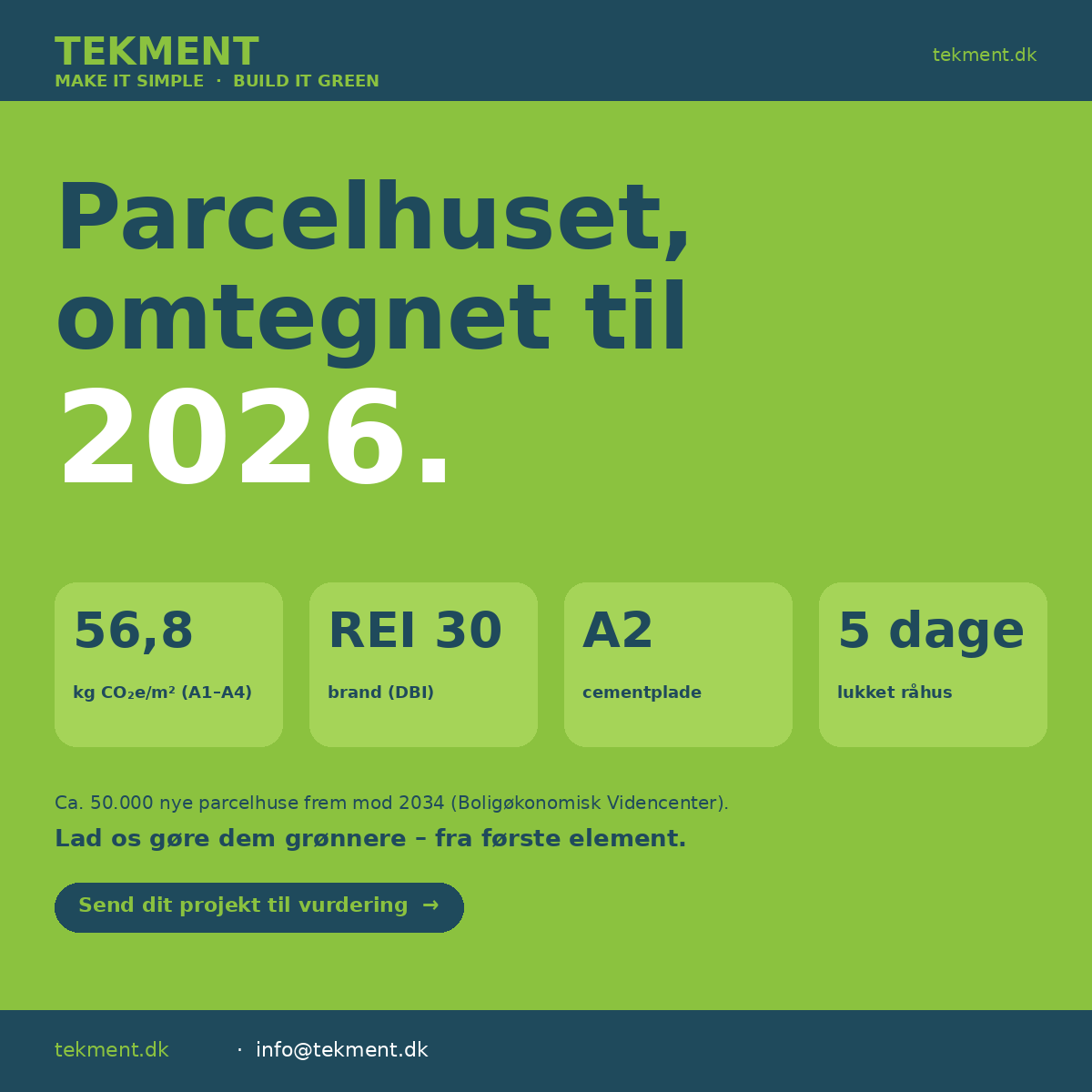
- Fire: CemPU's exterior Cetris board is A2-s1, d0 classified (non-combustible). Relevant when the holiday home sits close to forest and natural areas where fire spread is a real scenario.
- Thermal bridges: Tekment's CNC-machined corner panels eliminate the thermal bridges that typically arise in post-and-beam construction and timber-element joints. See The thermal bridge costs up to 30% of heat loss.
- Indoor climate: The cement surface gives a harder, more stable interior wall surface than gypsum-clad timber elements, and requires no maintenance in the form of repaints.
- CO₂: Timber elements have lower embodied CO₂, but CemPU's long service life, absent renovations and low operating need often produce a better overall climate account across 50 years. Documented in our LCA per EN 15804+A2.
Design and facade freedom
CemPU is a construction platform — the facade expression is free. Typical holiday homes can be built with render, timber cladding (vertical or shiplap), fibre cement, brick slips or Corten steel — all carried directly by CemPU without an additional structure. Architects who want the classic Danish holiday-home aesthetic with black timber cladding on the wall and roof can mount this directly on the CemPU panel without further ado.
Installation, schedule and logistics
For a 60–120 m² holiday home, external walls are typically installed in 3–5 days, and the closed shell (walls + roof) is up in 1–2 weeks depending on project complexity. From order confirmation to delivery on site we typically reckon 8–12 weeks depending on production window. Holiday homes are often at the ends of the distribution network (West Coast, Bornholm, North Zealand), but transport cost is still a modest part of the total price because the panels are light.
Documentation for building permit and homeowners' association
Even though a leisure building has fewer requirements than a year-round house, municipalities still require documentation for U-value, fire and structural performance. Our documentation pack covers all of it: BR18 §259 compliance, DBI fire assessment, structural report from Energihuset A/S, EN 15804+A2 LCA for future CO₂ requirements and EPD for all main materials.