
Four typical applications as an interior wall
1. Load-bearing interior wall in smaller buildings
Tekment 235 can be designed as a load-bearing interior wall that takes vertical load from the roof structure or floor separation. It is a fully fledged structural solution — not a cladding system. Load-bearing capacity is documented by Energihuset A/S' structural report 18.235, and at an interior position the panel is freed from wind and snow loads, which extends the practical scope of use. In residential construction, the 336 panel is still used primarily for external walls (because of U-value and acoustic requirements), while 235 may be suitable for transverse load-bearing interior walls where there are no acoustic requirements between dwellings.
2. Temperature-zone partition in commercial buildings
Production halls, warehouses and food-industry businesses often need to divide the building into zones with different temperature requirements — cold rooms, heated office sections, unheated warehouse. CemPU 235 with its U-value of 0.114 W/m²K provides a real insulation barrier between zones, without on-site brickwork or rendering. This is the core of fast conversion projects: a warehouse to be split into a warm/cold zone can have the new internal partition in place in 2–3 working days.
3. Non-load-bearing partitions in large buildings
In steel-frame halls, concrete-element buildings and glulam structures, Tekment 235 is used as in-fill non-load-bearing partitions where you want a solid, fire-safe and impact-resistant surface. Compared to steel/gypsum construction, CemPU has higher mass (better acoustics), better impact resistance and a surface that tolerates forklift traffic, high-pressure cleaning and tool work without damage.
4. Technical rooms and service rooms
Switchgear rooms, ventilation rooms, pump rooms and other technical rooms benefit from a fire-classified, solid interior wall. The A2-classified cement surface (EN 13501-1) of CemPU panels is relevant for requirements on section separation and fire-cell partition. REI 30 load-bearing capacity is documented by DBI.
Acoustics – what can a single 235 panel deliver?
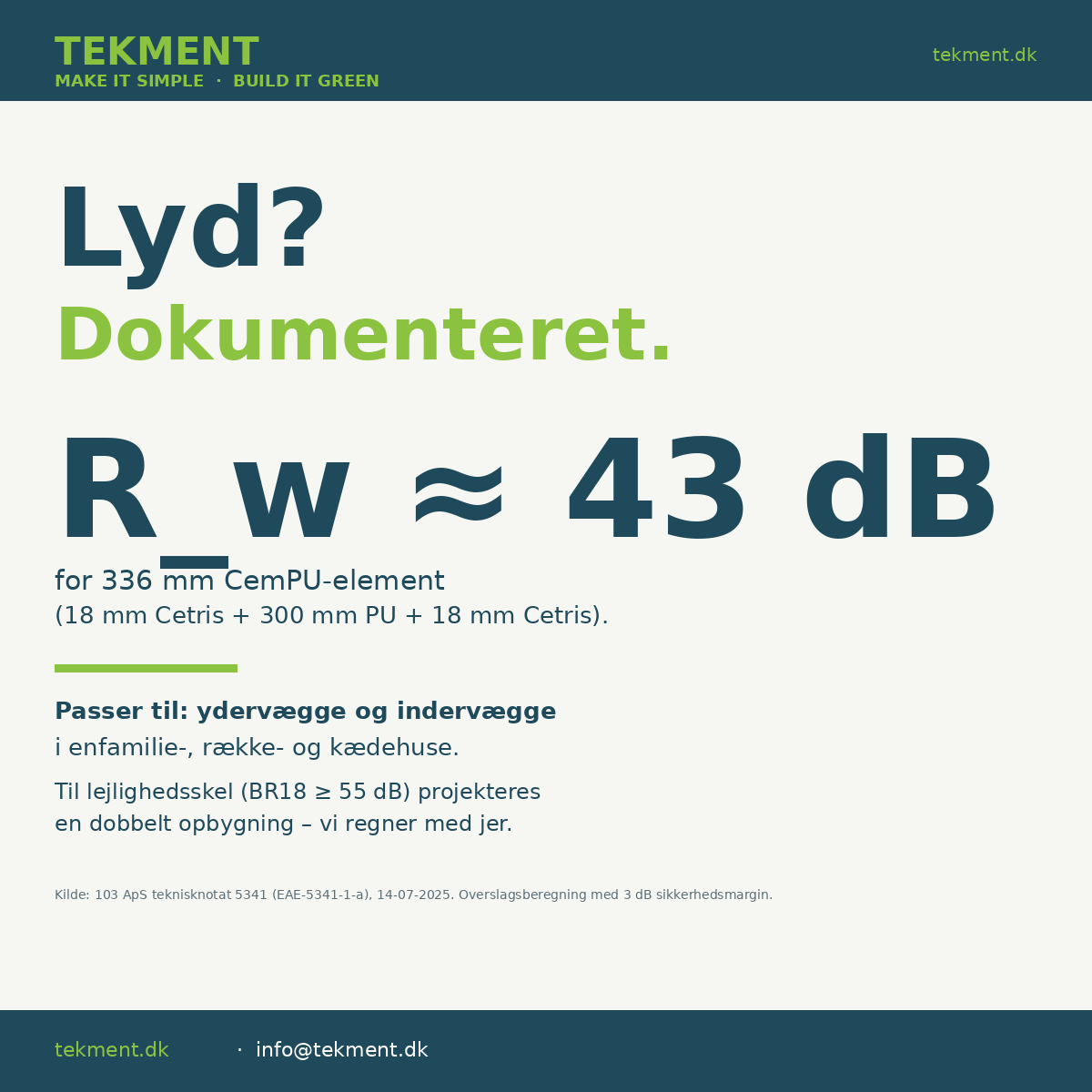
Sound reduction for a single 235 mm panel sits in the order of R_w ≈ 38–40 dB by the same calculation methodology that 103 ApS has applied to the 336 mm panel (where R_w ≈ 43 dB is documented with safety margin). That covers requirements for partitions within the same dwelling, between offices and between standard functional zones in commercial buildings.
For apartment separation (BR18 §§ 263-264, requirement R'_w ≥ 55 dB) and similarly stringent requirements, we design a double build-up (two CemPU panels with a cavity). Refer to Sound reduction in CemPU walls for in-depth calculations and design examples.
Fire – why CemPU is usable in escape routes and section separations
The exterior Cetris cement particle board on the CemPU panel is classified A2-s1, d0 per EN 13501-1 — the highest class for non-combustible materials. The cladding facing the PU core meets K1 10 B-s1, d0 (Class 1 cladding). The load-bearing structure itself is documented REI 30 by DBI (the Danish Institute of Fire and Security Technology).
In practice this means CemPU as an interior wall can be used in:
- Escape routes and shared access paths in commercial buildings
- Section separations (buildings in fire class 4)
- Fire-cell limits in production halls
- Partitions at exit conditions and stairwells up to 2 storeys
For higher fire requirements (REI 60 / REI 90) we design a special build-up with additional cladding — this is clarified per project.
CemPU interior wall vs. traditional alternatives
- Masonry partition (brick or aerated concrete): CemPU has far faster installation (days vs. weeks), no construction moisture, no on-site rendering and lower dead weight. Masonry interior walls still win on thermal mass and acoustics in massive build-ups — but at thinner masonry walls (70–100 mm) CemPU is competitive on both parameters.
- Steel/gypsum construction: Gypsum is significantly lighter, but also significantly less robust: punctures, cleaning damage and the need for special screw fastening make it unsuitable in halls and commercial environments with physical activity. CemPU tolerates direct loading and can be screwed/nailed into directly without anchors.
- Concrete-element interior wall: Wins on sound and robustness, but loses on weight (3–4× heavier), build time and need for heavy lifting equipment on site.
Installation and connections
The panels are delivered from Tekment's factory with CNC-machined openings for door units, windows facing other rooms, cable penetrations and ventilation. This reduces dust, noise and on-site labour for installing technical services. Screw fixing of fittings such as switchboards, machinery and shelves can be done directly into the cement board without anchors or board reinforcement.
Surface and finishing
The cement particle board can be painted directly (primer + two coats of masonry paint), rendered, clad or finished as the project requires. In technical environments and food-industry businesses, tile cladding or glass-fibre render + acrylic is popular because it provides a surface that can be washed with high-pressure cleaners without losing integrity.