
In a nutshell
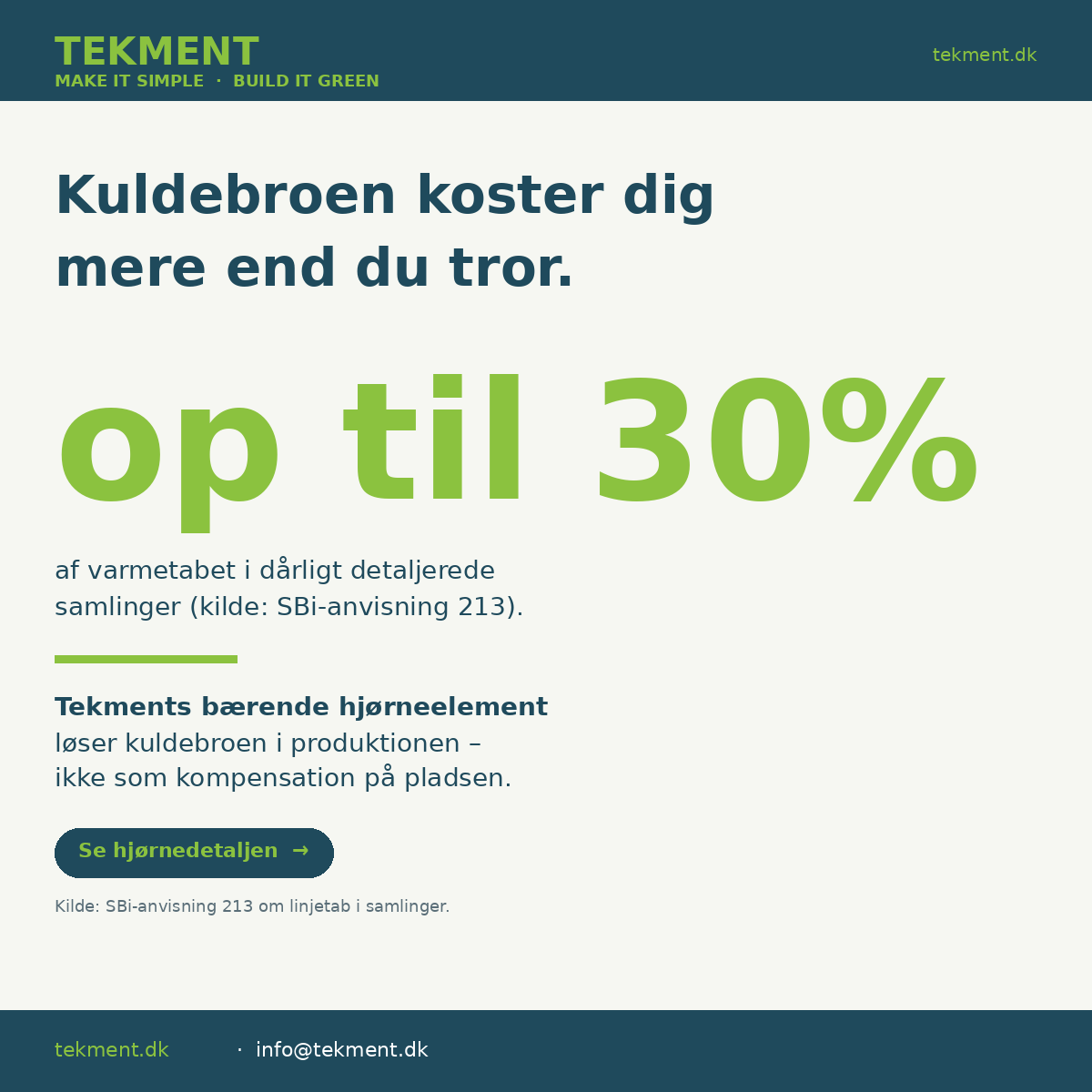
- 30% of heat loss: Poorly detailed linear losses at corner joints account for up to 30% of total transmission loss — per SBi guideline 213
- Condensation and mould: Cold internal surfaces create risk of condensation and mould formation in corners after 2–3 years of operation
- Tekment corner panel: Load-bearing corner with continuous insulation — no cold metal brackets or timber penetrations
- Documented Ψ-value: Linear loss is measured and can feed directly into the project's Be18 energy calculation
- Detailing problem solved in production: No site-dependent compensation — the thermal bridge is eliminated before installation
up to 30%
of heat loss
Typical linear loss
in poor corners
SBi 213
guideline
Documented
industry standard
Continuous
insulation
Tekment corner
eliminates the loss
Ψ-value
project-specific
For Be18
directly usable
How much of the heat loss do thermal bridges account for?
According to SBi guideline 213, poorly detailed linear losses at corner joints can account for up to 30% of the total transmission heat loss. That means lower internal surface temperature, risk of condensation, and in the worst case mould formation in the corners after 2–3 years of operation.
How does Tekment's corner panel eliminate the thermal bridge?
Our load-bearing corner panel is developed with continuous insulation. There are no cold metal brackets or wood penetrations. The joint has a documented linear loss (Ψ value) which can feed directly into the project's energy calculation.
What it means in practice
- Continuous insulation through the corner – no thermal bridge to compensate for
- Stable internal surface temperature – significantly reduced risk of condensation and mould
- Psi values can feed directly into the Be18 calculation
- Holds up in LCA and authority assessments too
Our experience is clear: If the detail is not properly solved, neither good intentions nor impressive LCA figures help. That is why we spend time on the corner detail – it is almost always critical.