
In a nutshell
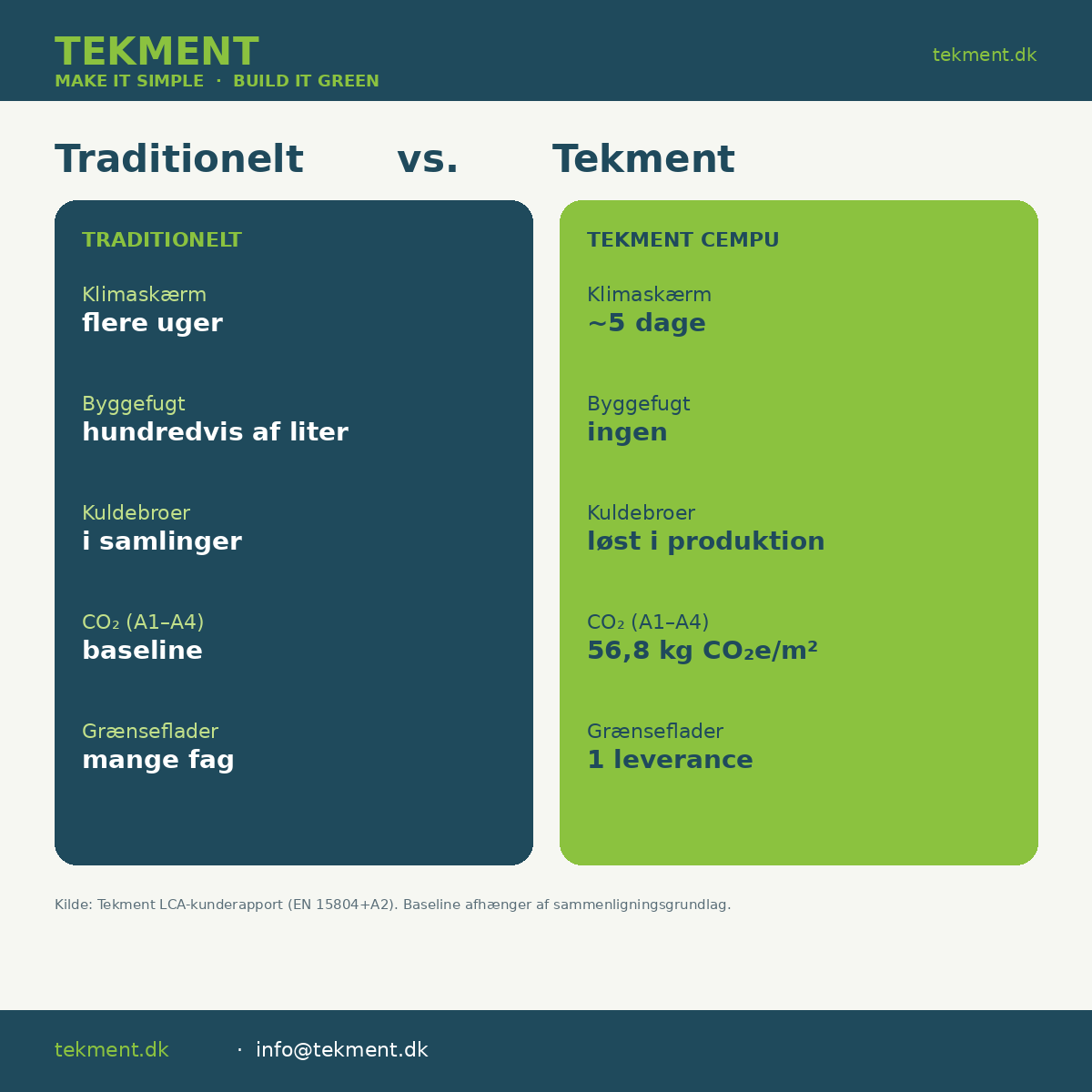
- U-value: CemPU 336 mm = 0.079 W/m²K vs. thickest Ytong Ultra+ 48 cm = 0.15 — almost twice the insulation in a thinner wall
- Wall thickness: CemPU is 112 mm thinner than Ytong Ultra+ 48 at the same U-value — gains ~5 m² extra interior floor area per 150 m² house
- Build time: CemPU installs in 2–5 days vs. AAC's 2–4 weeks of bricklaying — no mortar and no drying time
- Module A5 (LCA): CemPU has zero construction moisture — saves 60–120 litres of mortar per m² wall vs. AAC blocks
- Lifetime economics: Similar m² price at the element itself, but DKK 1,000–1,500/year lower heating bill and earlier handover
What is the difference between AAC blocks (Ytong) and CemPU?
Aerated concrete and CemPU are both sustainable building systems for external walls, but they solve different problems. Aerated concrete is a built-up system where the blocks are both load-bearing and insulating in the same material. CemPU is a prefabricated sandwich panel where cement particle boards sandwich a polyurethane (PU) core. The result is two fundamentally different wall build-ups — and that is where the comparison gets interesting.
What are the lambda values for AAC blocks and CemPU?
The lambda value (λ) describes how well a material conducts heat. The lower, the better the insulation. According to the Xella product list 2026-04:
- Ytong Solid Block (aerated concrete, density 340 kg/m³): λ = 0.088 W/mK
- Ytong Ultra+ (aerated concrete, density 290 kg/m³): λ = 0.072 W/mK — the best aerated concrete on the market
- Ytong Energy+ (hybrid block with Multipor core): λ ≈ 0.083 (aerated concrete) + 0.043 (Multipor)
- CemPU's PU core: λ ≈ 0.022 W/mK — about three times better than the best aerated concrete
What is the U-value for AAC blocks vs. CemPU?
U-value = λ ÷ wall thickness. The lower, the less heat loss. BR18's requirement for external walls is U ≤ 0.30 W/m²K, and for low-energy construction typically U ≤ 0.15. Here are the real numbers:
- Ytong Solid Block 36.5 cm: U = 0.088 / 0.365 = 0.24 W/m²K
- Ytong Ultra+ 40 cm: U = 0.072 / 0.40 = 0.18 W/m²K
- Ytong Ultra+ 48 cm: U = 0.072 / 0.48 = 0.15 W/m²K (thickest variant)
- CemPU 336 mm: U = 0.079 W/m²K (documented by Tekment)
CemPU 336 mm therefore delivers almost twice as good insulation as the thickest Ytong Ultra+ — in a wall that is 112 mm thinner.
What does that mean in practice?
For a 150 m² house with 80 m² of wall facing north, the difference between U 0.15 and U 0.079 means about 490 kWh less heat loss per year. At an electricity price of DKK 2.50/kWh, that is ~DKK 1,200 annually on the heating bill — or about DKK 60,000 saved over the building's 50-year life, all else equal.
How much interior space does CemPU save vs. AAC blocks?
Here it gets concrete for the architect: thinner external walls give more usable floor area on the same plot. Example for a rectangular 10 × 15 m house (external dimensions):
- Ytong Ultra+ 48 cm: interior net area ≈ 133 m²
- CemPU 336 mm: interior net area ≈ 138 m²
That is 5 m² extra inside for the same plot area — equivalent to an extra small room or a wider bathroom. It also makes a difference in the BBR (Danish building register) valuation.
How long does construction take with AAC blocks vs. CemPU?
Aerated concrete is built up on site. That typically takes 2–4 weeks for a single-family house (excluding scaffold time, weather delays and drying time before the next trade can come in). The masonry work itself is also weather-dependent: frost below +5 °C requires special adhesive mortars, and heavy rain can delay work.
CemPU is prefab. Panels are produced in the factory and installed by crane in 2–5 days. Weather only affects the actual installation days. There is no drying time, because CemPU is dry on delivery.
The effect on Module A5 in LCA
Built-up aerated concrete walls typically contain 60–120 litres of mortar per m² of wall, and the mortar must dry. That counts in Module A5 (construction moisture) in BR25's LCA requirements. CemPU has no construction moisture and therefore loads Module A5 much less. Read more about Module A5 and construction moisture.
Is CemPU more expensive than AAC blocks in total cost of ownership?
Raw m² price for a finished external wall sits in the same range for both systems (DKK 2,000–2,800/m² for solid built-up aerated concrete, DKK 2,550–3,000/m² for CemPU 336). But total economics shifts when you include:
- Build time: CemPU closes the shell 1–3 weeks earlier → less construction loan interest, earlier move-in
- Heat loss: Lower U-value = ~DKK 1,000–1,500/year lower heating bill over 50 years
- Space: ~5 m² more interior area → higher BBR value and resale price
- BR25 compliance: CemPU's low A5 construction moisture gives margin against BR25's tightened climate requirements without additional measures
Want to see how the numbers fall for your specific project? Use the price calculator and compare directly with aerated concrete and other building systems in the same chart.
When are AAC blocks the best choice and when is CemPU?
Neither aerated concrete nor CemPU is right or wrong — it depends on the project:
- Choose aerated concrete when: the project has unlimited time, masonry capacity is locally available, a single-material wall is desired, or when the design requires a built-up character and visible blocks inside.
- Choose CemPU when: build time is critical, the project is in a remote or arctic climate, BR25 compliance must be documented easily, or when slimmer walls and a better U-value give concrete benefits.